

Have you ever thought why certain AI applications generate content that nearly resembles human-created content, whereas others simply process information? Or perhaps you have posed the question, What is generative artificial intelligence?
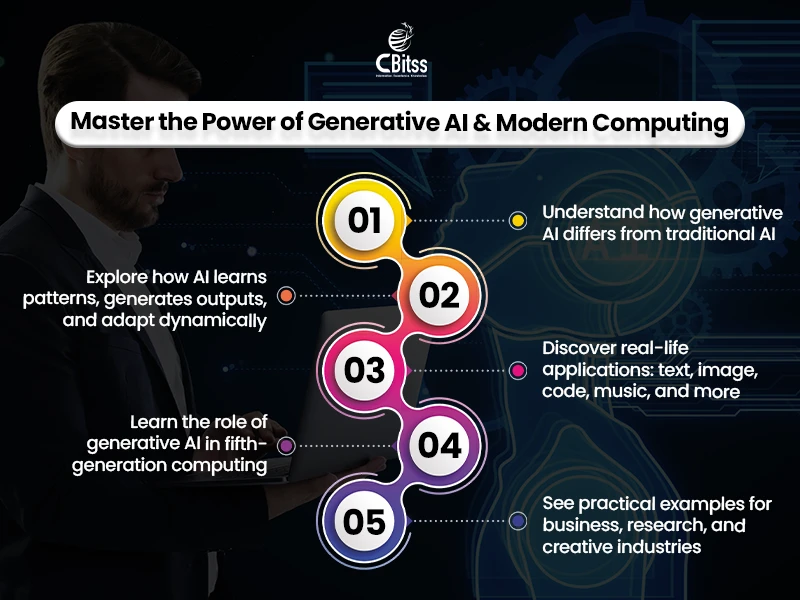
By the conclusion of this article, you will know how generative AI works, the distinction between traditional and generative AI, what is artificial intelligence in fifth generation computers, what types of AI generative AI falls under, and its applications in modern-day computing. You will also gain insight into real-life examples and new knowledge that extends beyond standard definitions and tutorials, enabling you to visualize how it impacts industries, innovations, and technology.
Generative AI is not only a new cool phrase, but it is also reinventing how machines think, generate, and cooperate with humans. The separation of creation, analysis, and logic into distinct layers enables developers to utilize generative AI to create smarter, more scalable, and maintainable systems.
For tips on launching your own website successfully, check out how to start and run a successful web design business.
Understanding the Layers of Generative AI
Generative artificial intelligence can be understood as one in which three fundamental components interact: data models, AI logic, and output generation.
Data Models: These are the basics, processing, and learning patterns of large datasets.
AI Logic: This expects and forecasts structures, and the system will be able to create new outputs.
Output Generation: Lastly, the AI generates output, whether a text, code, image, or even a simulation, which may be indistinguishable from the output created by a human.
Generative AI is not merely a prediction or categorization like traditional AI. Knowing what is artificial generative intelligence can enable developers to create systems that predict the needs of the human being and create new solutions.
If you want to streamline your finances, explore why business owners should consider taking up an online QuickBooks course.
How Generative AI Works in Practice
Generative AI Deep learning architectures are used to learn patterns and relationships among large datasets.
Examples: Systems such as GPT or diffusion models produce outputs by training on sequence probabilities in data.
Developers can use it in real-life applications such as text summarization, image synthesis, automated coding, and even to compose music.
Reactive flows ensure that the model is dynamically updated to new outputs in response to changes in underlying data.
APIs and integrations: It is easier to integrate with APIs and frameworks since the AI decouples logic and presentation, and therefore allows maintainable pipelines.
This is a practical method of demonstrating what type of artificial intelligence is generative AI, since it can be viewed as both creative nd reactive.
To plan your next venture efficiently, read how to write a business plan.
What is the difference between artificial intelligence and generative AI?
When posing the question of what is the difference between artificial intelligence and generative AI, the distinction lies in the intent and output.
| Feature | Traditional AI | Generative AI |
| Primary Function | Analyze, categorize, or predict outcomes using historical data | Synthesize content, learn context, and generate original solutions |
| Task Implementation | Requires explicit programming for every task | Learns patterns and adapts dynamically without explicit programming |
| Creativity | Cannot generate new content; limited to predefined rules | Can create novel outputs such as text, images, code, or music |
| Context Awareness | Minimal understanding of context | Understands context and produces multi-modal outputs |
| Role | Passive tool for analysis | Acts as a co-creator, enhancing human workflows |
Real-World Applications of Generative AI
- Codifying: Industry Automated writing, marketing text, and code generation.
- Design and Media: Generally, AI-created art, animation, and 3D models.
- Business Insights: Simulation of predictions and scenarios.
- Research: Hypothesis generation, synthesis of scientific data, and drug discovery.
- Personalization: Recommender systems that can create new user experiences.
By using them, developers can understand how generative AI differs from classical AI and utilize artificial generative intelligence creatively.
Boost your spreadsheet skills for work with the importance of Excel training in the world of work.
Types of AI: Where Generative AI Fits
The position of generative AI in the AI ecosystem can be better understood by understanding what type of artificial intelligence is generative AI. It is part of deeper, data-driven learning systems that employ neural networks, probabilistic modeling, and reinforcement learning methods. In comparison to the symbolic AI that uses explicit rules to produce outputs, the generative AI learns implicit structure and generates the output on its own.
This is especially useful in industries that need high adaptability, creativity, and scalability, such as creative arts, as well as automated coding and scientific research. Generative AI can be used to prototype and simulate quickly as well, so businesses can test their ideas fast and implement them effectively. In addition, it helps to create individualized experiences at scale and to make products and services more sensitive to the needs of individual users.
Gain insight into smart investment management by understanding CAPEX.
Challenges and Limitations of Generative AI
- Biased AI will generate biased results when trained using biased data.
- Excess dependence on generative models can lead to a decrease in human control in important systems.
- Resource-intensive models are very heavy computationally.
- Interpretability is a problem since the models are frequently black-boxed.
- To prevent the spread of inaccuracy, error management and monitoring must be carefully designed.
It is solving these challenges that will make what is generative artificial intelligence responsibly and sustainably applied.
Enhance your web design knowledge further by visiting how to start and run a successful web design business.
Future of Generative AI and Fifth-Generation Computing
Knowing what is artificial intelligence in fifth generation computers relates generative AI to the development of computing. The fifth-generation systems emphasize parallel processing, natural language understanding, and reactive intelligence. Generative AI is an ideal fit for these purposes, as it:
- Making machines participate in creation with humans.
- Multi-modal output.
- Improving cloud and edge computing architectures in terms of scalability.
To answer what is artificial intelligence in fifth generation computers, this generative AI can enable developers to create systems that are adaptable, intelligent, and resilient, as modern computing promises.
Learn practical strategies to foster teamwork by reviewing 6 ways to promote an open enterprise culture.
Best Practices for Implementing Generative AI
- Clearly separate model training, business logic, and output generation.
- Use modular architectures to make the code maintainable and scalable.
- Check outputs periodically on bias, accuracy, and quality.
- Integrate generative models with reactive frameworks to create dynamic applications.
- Uphold sound practices in AI ethics and be transparent in AI-generated content.
These best practices can make your work with what is generative artificial intelligence robust, responsible, and innovative.
Conclusion
Mastering what is generative artificial intelligence empowers developers and organizations to create intelligent, adaptive, and creative systems. By understanding how generative AI works,
what is artificial generative intelligence, what type of artificial intelligence is generative ai, and its role in fifth-generation computing, you can leverage this technology to build scalable, maintainable, and innovative solutions.
Improve personal effectiveness and soft skills through personality development course in Chandigarh.
Start experimenting with generative models now.
Combine them with APIs, structures, and reactive flows to develop content, insights, and applications that make AI go beyond what it is capable of doing.
Get acquainted with cloud integration and the latest computing paradigm to make the best use of generative AI in your projects.